
Special $30 Discount On Stucco Repair and Evaluation Services!!
For decades—since the mid-1970s—One Call has helped homeowners and property owners identify stucco problems and arrange evaluations, repairs, and replacements. We’ve built long-standing relationships with qualified tradesmen who can assess, fix, and solve most stucco issues.
Typical Stucco Installations
Synthetic Stucco (EIFS) and Hardcoat (Three-Coat) Stucco
Both synthetic stucco (EIFS) and traditional hardcoat stucco (three-coat stucco) can protect your home extremely well—often comparable to, and sometimes better than, other exterior wall systems—when they are properly installed and maintained. Most stucco-related problems aren’t caused by the product itself. Instead, they’re usually the result of installation details that allow moisture to enter the wall system. With the right investigation and corrections, proper maintenance can help protect your home for years to come.
What is EIFS (Synthetic Stucco)?
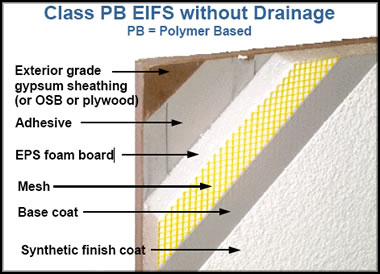
“EIFS” stands for Exterior Insulating and Finishing System. It was introduced in the United States in the 1960s, after being used in Europe.
The most common type in residential construction is PB EIFS—“polymer-based.” The polymer content strengthens and seals the system. Most PB EIFS systems are installed in three layers, applied in separate steps:
1. Insulation Layer (ETF Foam Board) - Usually expanded polystyrene, typically ¾” to 4” thick.
2. Base Coat - Includes reinforcing fiberglass mesh and a base layer applied over the fiberglass.
3. Finish Coat - The final layer provides the color and texture of the exterior.
What is Hardcoat Stucco?
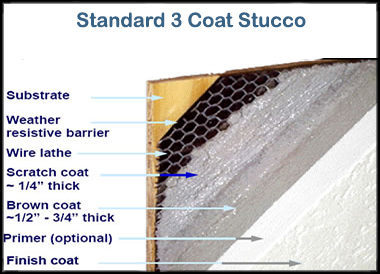
Hardcoat stucco—often called traditional three-coat stucco—has been used for hundreds of years. It’s typically applied over a wire mesh and troweled on in cement-like layers. Color can be built into the stucco or added through a finish coat applied afterward.
What Causes Most Of The Problems With Stucco?
Stucco systems are designed to keep the building envelope protected from water. When moisture penetrates behind the system—and can’t properly drain or dry—problems can develop over time.
For EIFS (Synthetic Stucco)
EIFS failures commonly occur when key moisture barriers are missing or improperly installed, such as:
1. Caulking that is incomplete, degraded, or never installed
2. Flashing that is missing, incorrect, or improperly placed
3. Leaks that enter around windows and penetrations
Windows are a major source of moisture entry in stucco homes, especially where gaps or cracks allow water into the wall cavity. Double-hung windows are often among the worst offenders.
Even small amounts of moisture can be a serious issue because it may take months for moisture to dry out. While trapped moisture continues to enter, the underlying structure can remain damp, eventually leading to wood rot.
For Hardcoat Stucco
Hardcoat stucco isn’t as airtight as EIFS, so some moisture can sometimes evaporate through the system. However, hardcoat installations can still develop nearly identical problems when moisture repeatedly enters—especially at:
1. Flashing location
2. Windows and trim transitions
When wood framing stays wet over time, it will eventually rot, even if the outer stucco surface appears intact.
Are Stucco Homes The Only Homes With Moisture Problems?
No. Moisture damage can occur in many types of exterior cladding systems.
It’s simply more difficult to test some cladding types for moisture intrusion, so moisture problems are sometimes overlooked—even when they’re present.
Moisture does significant damage to homes nationwide, often more than many people realize. All homes should be inspected to confirm the right protection is in place.
No. Moisture damage can occur in many types of exterior cladding systems.
It’s simply more difficult to test some cladding types for moisture intrusion, so moisture problems are sometimes overlooked—even when they’re present.
Our Goal
Our goal is to help you maintain your stucco properly—or determine what needs to be corrected—so your system can provide reliable protection for many years.
MoistureFree Protocol Stucco Evaluation
Our stucco evaluation fee is $130, but we're offering a discount:
Request and evaluation today and only pay $100.
If we perform stucco work for you, this evaluation fee will be credited to your account.
To Request An Evaluation
CLICK HERE
NOTE:
We normally charge a fee of $130 for this service but if you request the evaluation today, we will only charge you $100. We will then come to your home, evaluate your stucco issues and make recommendations on how to solve your stucco problems.
This fee will be credited to your account if we do work on your stucco.
If you do not wish to fill out our on-line form just:

If you happen to be outside the greater Houston calling area, call us toll free at 1(800) 606-9453.